
A home that is well insulated against the cold can turn into an oven as early as June. This is often the case in recently renovated homes where high-performance insulation has been installed on the inside without addressing summer overheating. Improving a home’s energy performance means balancing winter protection with summer comfort—not simply piling on layers of insulation.
Thermal insulation and summer overheating: the all-winter trap
Insulation is generally designed with heating in mind. Walls, roofs, windows: every element is intended to reduce heat loss when it’s cold outside. The problem arises when this same high-performance building envelope traps the solar heat accumulated during the day.
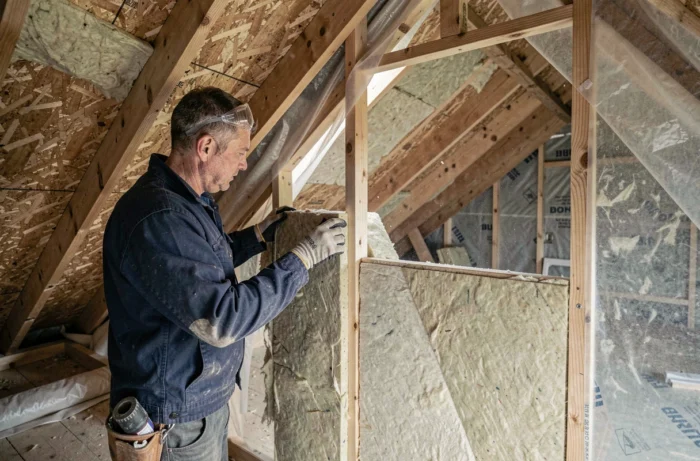
The orientation of glazed areas, the lack of external solar shading (shutters, brise-soleil, overhangs) and the low thermal mass of interior materials all make the problem worse. Lightweight insulation in the attic traps radiant heat without releasing it at night. Insulation against the cold does not guarantee a comfortable home in summer.
The French Senate proposed including summer comfort in the definition of high-performance renovation, although this proposal was not in force as of October 29, 2026. This signals that regulations are gradually catching up with what experience on the ground has already made clear: the building envelope can no longer be designed without taking heatwaves into account.
In practice, before choosing insulation, check three summer-related factors: the material’s thermal lag (its ability to slow the penetration of heat), whether cross-ventilation is possible at night by opening windows on opposite sides, and whether the south- and west-facing façades have external solar shading. Technical resources on these trade-offs are available at https://www.techniquehabitat.fr, which details solutions suited to different home layouts.
Ventilation and airtightness: two inseparable projects
Replacing single-glazed windows with high-performance double glazing and insulating the walls drastically reduces unwanted air infiltration. That’s the goal when it comes to heating. The downside is that moisture generated inside the home (from cooking, bathrooms and breathing) can no longer escape naturally.
Without adequate air exchange, moisture builds up and damages the building. Mold in wall corners, condensation on windows, stale air: these symptoms are common in newly insulated homes where no one has addressed the ventilation.
The best approach is to consider ventilation and airtightness from the outset of the project, not as an afterthought. Checking the interfaces between different work packages (window-frame-to-insulation junctions, duct penetrations) helps prevent thermal bridges and air leaks that can cancel out some of the energy savings.
Single-flow or double-flow mechanical ventilation: what really changes
A single-flow mechanical ventilation system extracts stale air and lets fresh air in through façade vents. It is suitable for most renovation projects, provided the vents are correctly sized after insulation work.
A double-flow mechanical ventilation system recovers heat from the extracted air to preheat incoming air. It can be highly beneficial in very airtight homes, but installing one during a renovation often requires a duct network that is difficult to fit into the existing building. Whether it makes sense depends on the home’s size, the attic layout and the budget available for installing the ducts.
Energy assessment before work begins: what really guides your choices
Starting work without an assessment means treating the symptoms without knowing the cause. An energy performance certificate (DPE) provides a snapshot of the home’s rating, but it does not tell you everything about which improvements should take priority.
One point to watch: the DPE calculation for some homes heated with electricity is due to change on January 1, 2027. The rating of some homes may change even if no work has been carried out. Checking the updated rating before deciding on a renovation plan helps avoid basing the work on outdated information.
Beyond the DPE, a detailed energy audit identifies heat loss by building element:
- Roof and attic, often responsible for the largest share of heat loss in a detached house
- External walls, distinguishing between internal insulation (less expensive, but reduces living space) and external insulation (more thermally efficient, but more costly)
- Ground floors, which are sometimes overlooked even though an uninsulated floor above a crawl space or cellar can cause immediate discomfort underfoot
- Windows and thermal bridges at wall junctions, where heat loss can be concentrated even in a building that is otherwise well insulated

Efficient heating and financial assistance: check the rules before signing
Replacing an old heating system with more efficient equipment (a heat pump, condensing boiler or pellet stove) is often the most visible part of a renovation. However, a common mistake is to replace the boiler without insulating first, which is like heating a sieve.
The logical order is insulation, ventilation, then heating. A well-insulated home needs a less powerful heating system, which costs less to buy and run.
MaPrimeRénov’ grants: rules that keep changing
Renovation grants are regularly updated. Since September 1, 2026, work funded through MaPrimeRénov’ “single-action” grants in mainland France has been refocused on certain types of equipment and situations. Insulation alone is now directed to the comprehensive renovation pathway. Since the rules depend on the pathway chosen and the date the application is submitted, confirming the requirements with France Rénov’ before committing remains the only reliable precaution.
A renovation plan that combines insulation of the building envelope, ventilation improvements and heating replacement as part of a coordinated project can achieve a jump of several energy-rating classes. This is also the kind of comprehensive renovation that grant schemes increasingly favor, rather than isolated upgrades.
Durably improving a home’s energy performance is not simply a matter of ticking off a list of individual jobs. The order of work matters just as much as the materials, and summer comfort should carry as much weight in every decision as heating savings.