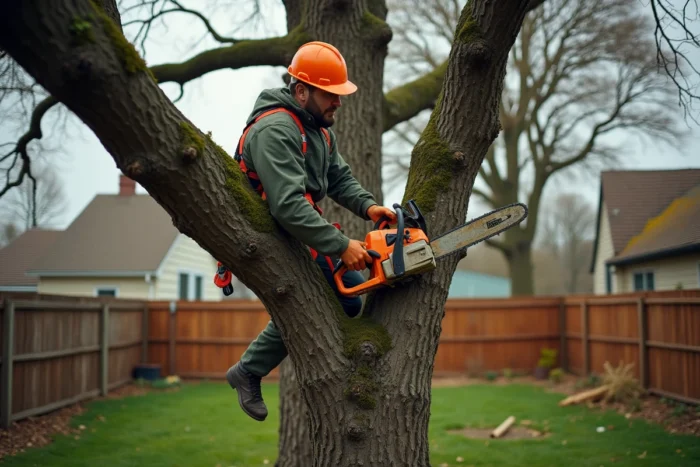
A linden tree fifteen meters tall leans toward the neighbor’s roof, and the tree surgeon announces a hefty bill. Before signing the estimate, one naturally wonders if the tax authorities will cover part of the cost. The answer depends on the type of intervention, the owner’s status, and a few administrative details that make all the difference between an accepted tax credit and a reassessment.
Work at human height or intervention with a lift: the tax dividing line
The tax administration’s doctrine does not mention pruning or felling in the official list of activities eligible for the tax credit for personal services. It merely refers to small gardening work, which leaves it with a wide margin of appreciation in case of an audit.
In practice, the criterion used by the tax services is that of the intervention “at human height,” without the use of specialized equipment. Trimming a shrub with pruning shears, cutting the low branches of a fruit tree with a pole saw: this type of service falls under small gardening work. As soon as one goes up in a lift, uses a chainsaw, or a tree climber-pruner works at height, one steps outside the perimeter.
When hiring a professional for the felling and pruning of large trees, the service is almost always reclassified as specialized work, thus not eligible for the 50% tax credit.

Gardening tax credit: spending cap and conditions to meet
For work that falls within the scope of small gardening tasks, the tax credit amounts to 50% of the expenses incurred, up to a limit of 5,000 euros per year per tax household. This ceiling can be increased depending on the number of dependents.
Three conditions must be met simultaneously:
- The work is carried out at the taxpayer’s home (primary or secondary residence), by an employee or an approved personal services organization.
- The intervention remains routine maintenance, without heavy motorized equipment or work at height.
- The service provider issues a compliant tax certificate, essential for justifying the expense to the administration.
Without this certificate, the tax credit is denied even if all other conditions are met. It is noted that many individuals forget it or do not request it from their service provider, which completely nullifies the tax advantage.
Immediate advance: deduct without waiting for the declaration
A recent development simplifies household cash flow: the immediate advance of the tax credit. Instead of paying the full bill upfront and then waiting for reimbursement the following year, the taxpayer only pays the remaining half at the time of the service. The provider must be connected to the system via URSSAF for this mechanism to work.
This immediate advance does not change the eligibility conditions. It simply accelerates the payment of assistance, making the tax credit more tangible for low-income households.
Landlord: deduct pruning from rental income
Online content almost exclusively focuses on the personal services tax credit, but there is another tax lever that landlords often overlook. When a property is rented and rental income is declared under the real regime, pruning or felling expenses can be deducted as property charges.
The condition: the work must qualify as maintenance or safety of the property, not improvement. Felling a dead tree that threatens the tenant’s roof is considered maintenance. Replanting a decorative garden to enhance the property is considered improvement, and the deduction will be denied.
A key point to remember: one cannot combine the personal services tax credit and the deduction on rental income for the same expense. The owner who lives in their property uses the tax credit (if conditions are met). The owner who rents out their property uses the property deduction. The two regimes mutually exclude each other.
Justifying the necessity of work in case of an audit
For a landlord, the invoice alone is not always sufficient. In case of verification, the administration may request proof that the intervention addressed a need for maintenance or safety. Keeping photos of the tree before intervention, a letter from the tenant indicating the danger, or an arboricultural diagnosis written by a professional significantly strengthens the case.

Felling dangerous trees: a special case in taxation
A sick, uprooted, or threatening tree poses a safety issue. In this specific case, the responses vary regarding tax treatment. Some taxpayers have obtained the tax credit for felling carried out by an approved provider, while others have been denied on the grounds that the intervention involved specialized equipment.
The difficulty lies in the fact that the law does not provide a distinct category for emergency felling. The tax authorities apply the same filter: intervention at human height or not. A small-diameter tree, felled manually without a lift or machinery, may remain eligible. A large tree requiring a crane or dismantling in sections is not.
To limit the risk of rejection, one can ask the provider to detail the invoice by separating items: disposal of green waste (eligible as part of routine maintenance) and the felling itself (potentially excluded). This breakdown gives the administration a clear basis to accept at least part of the expense.
Summary of eligible and non-eligible work for the tax credit
- Lawn mowing, trimming hedges and shrubs at human height, leaf collection, light brush clearing: eligible for the 50% tax credit.
- Height pruning with a lift, chainsaw, or climbing techniques: not eligible for the personal services tax credit.
- Tree felling: not eligible except in very limited cases (small tree, manual intervention without heavy motorized equipment).
- Maintenance work on a rented property (real regime): deductible from rental income, provided it qualifies as maintenance.
The boundary between routine maintenance and specialized work remains the determining criterion. Before signing an estimate, asking the provider if they are approved for personal services and if they can provide the tax certificate helps avoid unpleasant surprises at the time of declaration.