When faced with a bank overrun with brambles or a flowerbed border spilling onto the path, you don’t use the same tool. The choice between a brush cutter and a string trimmer depends less on preference than on the exact nature of the work to be done. These two machines share a similar silhouette (a handle, a motor, a rotating cutting head), but their design is intended for radically different terrain situations.
Motorization and battery voltage: the boundary has shifted
For a long time, the rule was simple: electric string trimmer for finishing touches, gas brush cutter for heavy work. This distinction no longer holds true.
The lithium battery ranges have been structured into two tiers. The 18 V string trimmers remain limited to lawn finishing and small gardens. In contrast, the 36 V brush cutters with interchangeable heads (line and blade) now match entry-level gas models in cutting capacity.
A model like the Makita DUR368AZ, which operates on 18 V x2, is positioned for professional use with a significant cutting width. Saying that the battery is still reserved for weekend DIY no longer makes sense in 2026. Understanding the difference between brush cutter and string trimmer now depends as much on the voltage and battery life as on the type of motorization.
The gas model retains a clear advantage in one area: endurance. On a sloped terrain of several hundred square meters covered with dense vegetation, a Stihl or Husqvarna gas brush cutter can run continuously as long as the tank is full. With a battery, you depend on the number of spare batteries available.
String trimmer on maintained grass: what the tool does really well
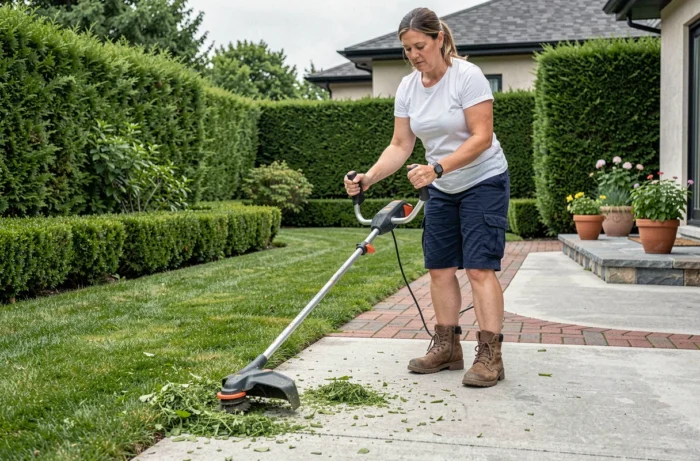
The string trimmer excels in a specific situation: finishing what the lawn mower cannot reach. Along a low wall, around a tree base, between the slabs of a terrace. We’re talking about soft grass, already short or of moderate height.
Its rotating nylon line cuts cleanly without damaging hard surfaces upon contact. It’s a precision tool, not a force tool. Its light weight (often less than three kilograms for electric models) allows for one-handed operation, arm extended, for half an hour without excessive fatigue.
Feedback varies on this point, but beyond a terrain of more than a few hundred square meters, a string trimmer shows its limits: the line breaks on woody stems, the motor overheats in tall grass, and the working posture becomes uncomfortable on large areas.
Brush cutter on difficult terrain: brambles, slopes, and wasteland
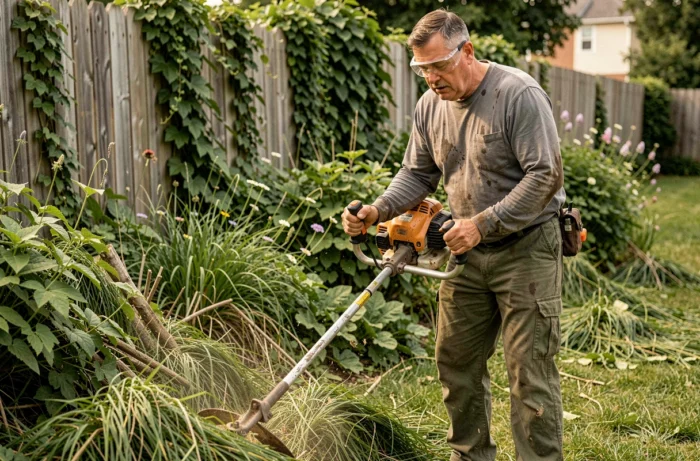
When tackling a plot left fallow for several months, the string trimmer is useless. The stems exceed knee height, brambles mix with grasses, and young shrub regrowth begins to settle in. This is the territory of the brush cutter.
Its superior motor power and especially its interchangeable cutting systems make the difference:
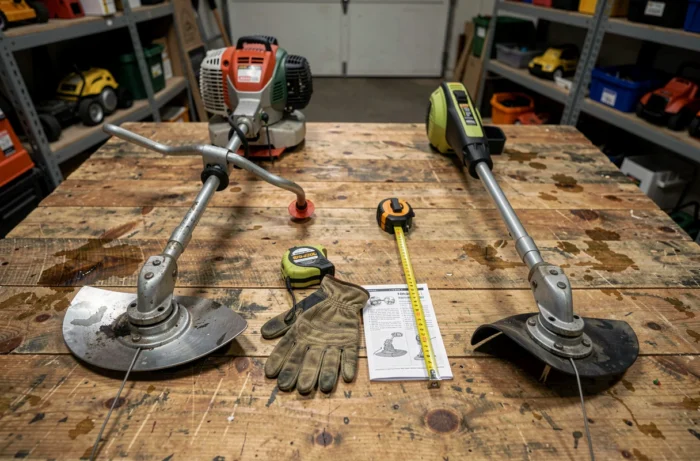
- The reinforced nylon line (thicker than that of a string trimmer) handles tall grasses and nettles with ease
- The three-tooth blade or steel knife tackles brambles, young tree shoots, and semi-woody vegetation
- The grass disc allows for quick clearing over large areas on flat or sloped terrain
The carrying harness, standard on brush cutters, distributes weight across the shoulders and hips. On a sloped bank, it’s this harness that allows for an hour of work without destroying your back. A string trimmer held at arm’s length in the same situation would cause pain within minutes.
Mandatory maintenance of plots: a regulatory constraint
Clearing is not always a choice. In areas subject to legal obligations for clearing (fire risk zones in particular), only a brush cutter can meet regulatory requirements. A string trimmer will not be able to handle the vegetation covered by these obligations.
Choosing between brush cutter and string trimmer: concrete criteria
You don’t choose between these two tools as you would choose between two brands. You choose based on what you have underfoot. Here are the situations that settle the debate:
- Regularly maintained garden, lawn mowed weekly, flowerbed borders and paths: the string trimmer is sufficient and costs significantly less
- Mixed terrain with lawn areas and a sloped section that is hard to access with a mower: a 36 V battery brush cutter offers the necessary versatility
- Large fallow plot, established brambles, woody vegetation: gas brush cutter with steel blade, without hesitation
- Occasional cleaning work on a terrain that will then be maintained with a string trimmer: renting a gas brush cutter for the initial restoration avoids unnecessary purchase
The price reflects this hierarchy of use. A basic electric string trimmer costs a fraction of the price of a Stihl or Husqvarna gas brush cutter. Battery models fall between the two, with an additional cost related to the batteries themselves (often sold separately).
Two complementary tools, not interchangeable
Many gardeners end up owning both. The brush cutter opens up the terrain, while the string trimmer maintains the finishing touches. Using a brush cutter to edge along a stone wall damages the blade and the wall. Using a string trimmer in brambles breaks the line every thirty seconds.
The right reflex before purchasing: go see the terrain, assess the height and density of what is growing, and choose the tool that corresponds to the actual task, not to the idea you have of it from the store aisle.