A European-quality cylinder mounted on a hollow-core door offers no protection. Securing a home relies on the coherence between the door leaf, the frame, the reinforcing hardware, and the locking mechanism. Neglecting a single link creates an exploitable flaw in just a few seconds. Therefore, locking equipment should be considered as a system, not as an addition of isolated products.
Anti-pinch corners and hinge reinforcements: the protections that product sheets overlook
The majority of break-in attempts do not target the cylinder first. The crowbar remains the most common tool, attacking the junction between the door leaf and the frame. Without an anti-pinch corner, the gap between the door and the frame provides enough leverage to force the entire assembly, even if the lock holds.
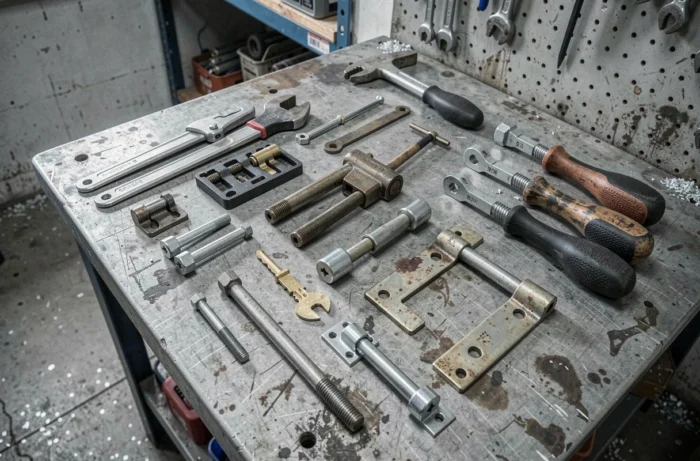
An anti-pinch corner made of steel is fixed along the entire height of the opening side. It eliminates the exploitable gap and protects the bolt from the separation of the frame. On the hinge side, hinge reinforcements (or security hinges) prevent the door from being lifted off its hinges. These two pieces of equipment are often absent from standard doors supplied by manufacturers.
We also recommend checking the condition of the frame itself. A softwood frame or a poorly sealed frame in the masonry renders any multipoint lock ineffective. A metal frame reinforcement, secured with through bolts in the wall, completes the protection chain on the door frame side.
To identify the appropriate materials for your configuration, the equipment from Serrurerie Auberge En Ville covers all of these mechanical reinforcements.
A2P certification of locks: what the level really evaluates
The A2P certification tests the resistance of a lock cylinder against tool attacks in a laboratory. There are three levels, corresponding to increasing durations and techniques of break-in. The first level covers simple attacks (picking, bumping), while the higher levels incorporate heavier destructive tools.
This certification applies to the entire mechanism (cylinder, lock body, strike) and not just the cylinder. A certified cylinder installed in a non-certified lock body provides no A2P guarantee for the installation. We regularly observe hybrid setups that give a false sense of security.
A2P and the number of locking points
A multipoint locking system (three, five, or seven points) distributes resistance across several areas of the door leaf. The number of points is not an A2P criterion in itself. The certification evaluates the resistance of the device, not the number of bolts. A three-point lock certified A2P at a higher level offers better protection than a five-point lock without certification.
This distinction also matters for home insurance. Some contracts explicitly require an A2P certified lock or a minimum number of locking points. The absence of the required equipment may compromise compensation after a burglary. Check the specific conditions of your contract before any purchase.
Protection of the cylinder against pulling and picking
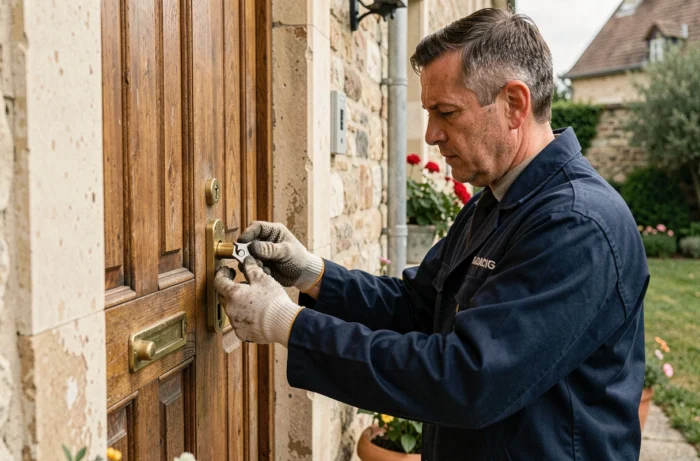
The cylinder often protrudes from the rose by several millimeters, making it vulnerable to pliers or extractors. A cylinder protector (or security rose) made of hardened steel, fixed with internal screws, prevents any mechanical grip on the cylinder from the outside.
In terms of picking, standard pin cylinders can be manipulated with a basic kit. Paracentric profile or disc models offer significantly higher resistance. When replacing a cylinder, we recommend choosing a model that includes anti-bumping, anti-picking, and anti-drilling protection, ideally certified according to the EN 1303 standard with a high resistance grade.
- Hardened steel cylinder protector fixed from the inside, with no screws accessible from the outside
- Paracentric profile or disc cylinder with integrated anti-bumping protection
- Cylinder length adjusted to the door leaf to avoid any protrusion on the outside
Secondary access: service doors, garage, and windows
Secondary access points represent a vulnerability angle often more critical than the front door. A tilting or sectional garage door without additional mechanical locking can be forced with a lever in a matter of seconds. A thumb turn lock or a manual locking system on the guide rail blocks the door independently of the motorization.
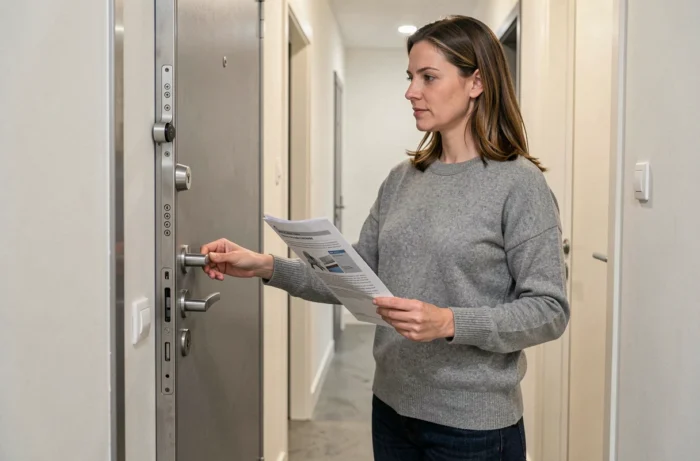
Service doors, often made of PVC or lightweight wood, deserve at least a multipoint surface-mounted lock with a reinforced strike. The classic mistake is to invest in the front door while leaving the basement or laundry door with a simple latch.
Windows and sliding doors
Windows accessible from the ground floor or a balcony require key-operated locks or sturdy metal restrictors. Lockable handles replace standard locks without modifying the frame. For sliding doors, a rail block or security bar prevents forced sliding.
- Additional mechanical lock on garage door (thumb turn or rail lock)
- Multipoint surface-mounted lock on service and basement doors
- Key-operated handle or lockable latch on accessible windows
- Security bar or rail block on sliding doors
The coherence of the overall system determines the actual level of protection. Reinforcing the front door without addressing secondary access, the cylinder without protecting the frame, or the lock without checking the requirements of home insurance amounts to leaving a breach open. Each piece of locking equipment should be evaluated based on the configuration of the door, the frame, and the complete environment of the home.