We just returned from a market in Portugal or a flea market in Tunisia with three hand-painted ceramic plates, and the question arises when packing the cabin luggage: will it pass through Air France’s security check, or will we have to abandon everything on the conveyor belt? The answer depends on the material, the packaging, and a few easy-to-avoid pitfalls.
Butter knives, hidden blades: what really gets blocked at security
Tableware itself (plates, bowls, cups) is not prohibited in the cabin. What poses a problem is anything that can cut or could potentially cut. Security agents apply a simple logic: if the item can be used as a weapon, it won’t pass.
Metal cutlery is excluded, including those deemed harmless. A stainless steel butter knife will be confiscated just like a steak knife. Cheese knives, fondue forks, and skewers fall into the same category. This point is often underestimated when packing a complete table set purchased while traveling.
Ceramic, porcelain, or glass pieces pass through security without difficulty as long as they do not have sharp edges. A chipped dish with a sharp edge could attract attention. When in doubt, wrap it up and voluntarily inform the agent during the scan.
To properly anticipate the rules regarding tableware in cabin luggage on Air France, it is better to systematically separate decorative pieces (allowed) from cutting utensils (prohibited in the cabin, to be placed in the hold).
Anti-breakage packaging in the cabin: the method that holds up
Breakage is the real practical risk. Cabin luggage undergoes movements in the overhead compartment, especially during turbulence and landing. Air France’s pages remind passengers of the allowed dimensions and weight, but do not detail the packaging technique.
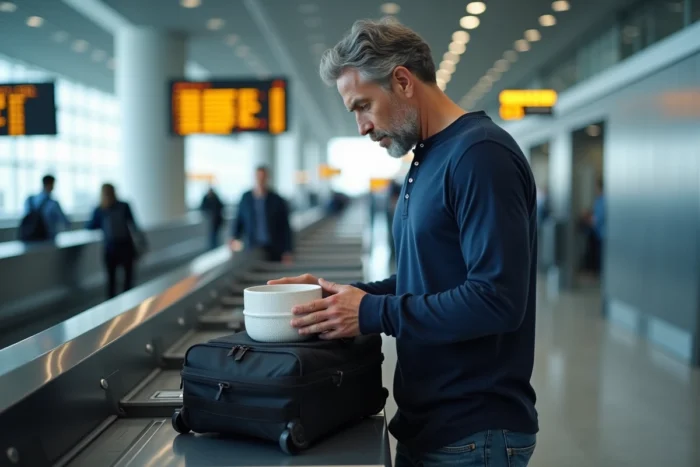
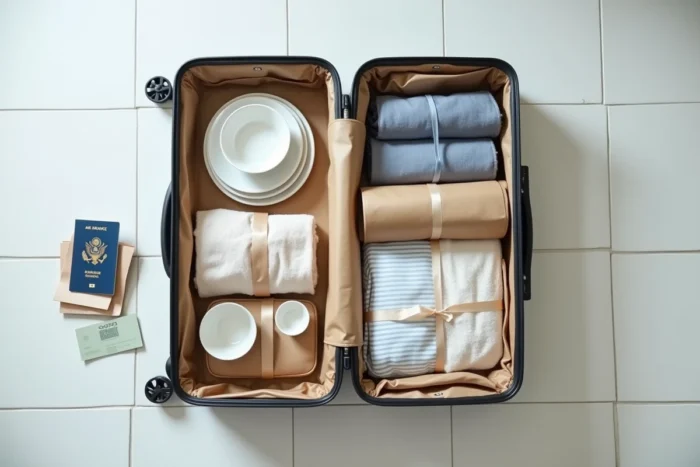
We start from a principle: each piece must be individually isolated. Two stacked plates without separation will clash and crack, even in a well-padded bag. Here’s the method that works in practice:
- Wrap each piece in bubble wrap or, if not available, in a thick garment (sweater, scarf). Fabric absorbs shocks better than newspaper, which compresses quickly.
- Place the wrapped items in the center of the luggage, never against the outer walls. Rolled clothes around them create a natural cushion on each side.
- Lay the pieces flat rather than on their edge. A plate laid flat withstands pressure better than a standing plate that can pivot.
- Avoid overpacking the luggage: an overly tight bag leaves no cushioning margin, and the zipper exerts direct pressure on the contents.
If transporting particularly fragile pieces (fine porcelain, blown glass), a small hard case like a vanity or a plastic box slipped inside the cabin luggage offers additional protection.
Liquids associated with tableware: the trap of food souvenirs
We rarely bring back tableware alone. There is often a bottle of olive oil, a jar of sauce, or artisanal vinegar in the same bag. And this is where passing through security becomes complicated.
The rule of containers with a maximum of 100 ml remains strictly enforced in the cabin on Air France as on all airlines. Each container must fit into a single resealable transparent plastic bag with a maximum capacity of one liter, with one bag per passenger.
In practical terms, a 250 ml bottle of olive oil does not pass in the cabin. Even a small jar of artisanal jam often exceeds the limit. Returns on this point vary by airport, but the official guideline leaves no room for maneuver: any container over 100 ml will be confiscated, regardless of the fill level.
The most reliable solution remains to place liquids in the hold (in checked baggage, well protected in a waterproof bag) and to keep only dry tableware in the cabin. This way, you avoid losing a product that sometimes cost more than the plates themselves.
Dimensions and weight of Air France cabin luggage: where to fit the tableware
Tableware takes up space and especially weight. Handmade ceramics, in particular, are dense. Three terracotta plates can easily weigh one to two kilos.
Air France allows a carry-on bag whose dimensions must not exceed the limits set by the airline (including wheels and handles), plus a personal accessory like a small bag. The weight varies depending on the travel class and the fare chosen. On some fares, the carry-on bag is not included and must be added as an option.
Before closing the suitcase, weigh everything. Discovering an overweight bag at boarding requires either transferring items to the hold (with an increased risk of breakage) or paying a surcharge. A few precautions can avoid this scenario:
- Weigh the complete bag with a hook scale before leaving for the airport.
- Distribute the tableware between the cabin luggage and the checked baggage if the quantity is significant.
- Favor lightweight pieces in the cabin (fine earthenware, melamine) and place the heavier ones in the hold, better protected by suitable padding.
On short-haul flights, space in the overhead compartments is limited. If the plane is full, the staff may request to place the carry-on bag in the hold at the last moment. Keeping the tableware in solid packaging even in the cabin protects against this scenario.
Transporting tableware in the cabin on Air France does not pose major difficulties as long as you separate cutting pieces (hold) from decorative pieces (cabin), wrap each item individually, and keep liquids out of the carry-on bag. The real time-saver is preparing this packaging the night before, not in the airport hall.