The seven main chakras are each associated with a color from the visible spectrum, from red to violet. This correspondence between chakra colors and body areas is based on ancient tradition, but it also resonates with recent physiological observations. What truly distinguishes each energy center, and on what criteria can we compare their respective attributes?
Chakras and the Nervous System: An Anatomical Correspondence
The link between the traditional location of each chakra and the structures of the autonomic nervous system deserves to be examined beyond the simple symbolism of colors.
The locations of the seven major chakras coincide very precisely with the main nerve plexuses and endocrine centers of the human body (sacral plexus, solar plexus, thyroid glands, pituitary gland). Meditations associated with these areas produce measurable changes in brain wave activity.
This perspective does not imply that chakras are physical organs. Several contemporary practitioners prefer to speak of inner mapping rather than anatomical structures. Chakras function as a system for locating sensations, emotions, and tensions, not as a medical diagnosis.
Understanding the colors of the chakras and their meaning from this dual perspective, symbolic and physiological, helps to grasp why each energy center is associated with a specific body area and a distinct function.
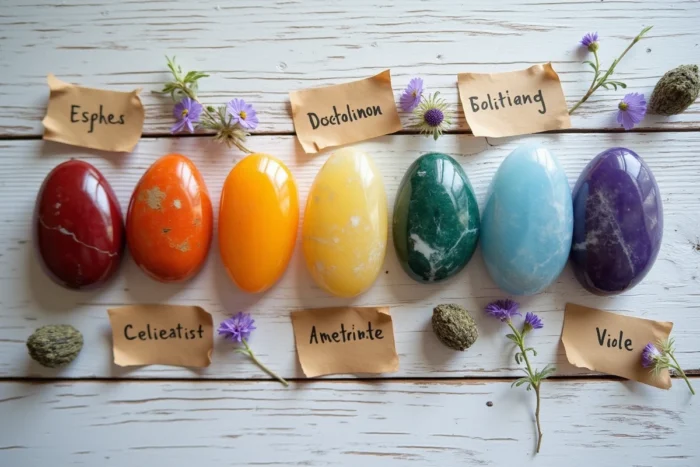
Comparative Table of the Seven Chakras: Color, Location, and Function
The table below synthesizes the attributes of each main chakra. It allows for a quick visual reference of the correspondences between color, body area, associated endocrine gland, and traditional energy function.
| Chakra | Sanskrit Name | Color | Location | Associated Gland / Plexus | Main Function |
|---|---|---|---|---|---|
| Root | Muladhara | Red | Base of the spine | Sacral plexus | Grounding, security |
| Sacral | Svadhisthana | Orange | Lower abdomen | Gonads | Creativity, emotions |
| Solar Plexus | Manipura | Yellow | Between the navel and sternum | Solar plexus, pancreas | Will, confidence |
| Heart | Anahata | Green | Center of the chest | Thymus | Love, compassion |
| Throat | Vishuddha | Blue | Throat | Thyroid | Communication, expression |
| Third Eye | Ajna | Indigo | Between the eyebrows | Pituitary gland | Intuition, perception |
| Crown | Sahasrara | Violet | Top of the skull | Pineal gland | Consciousness, spirituality |
What stands out from this table is the progression of the light spectrum: red, the lowest frequency, is associated with the most physical functions. Violet, the highest frequency, corresponds to the most abstract functions. Each chakra color follows the rise in frequency of the visible spectrum.
Differences Between the First Three and the Last Three Chakras
The three lower chakras (root, sacral, solar plexus) are linked to concrete needs: survival, relationship to the body, personal assertion. Their colors, red, orange, and yellow, belong to the longest wavelengths of the spectrum.
The three upper chakras (throat, third eye, crown) concern expression, subtle perception, and expanded consciousness. Their colors, blue, indigo, and violet, correspond to the shortest wavelengths.
The heart chakra, in the center, serves as a junction. Its green color is situated in the middle of the spectrum. In yogic tradition, Anahata is the tipping point between the physical and the subtle. An imbalance at this level manifests as both relational tensions and chest discomfort.
What This Distribution Implies in Practice
Working on the lower chakras often requires physical approaches: movement, grounding, nutrition. The upper chakras respond more to meditation, silence, and visualization exercises.
- The root chakra (red) is rebalanced through walking in nature, contact with the earth, and grounding postures like Tadasana
- The solar plexus chakra (yellow) responds to abdominal breathing exercises and practices that strengthen confidence
- The third eye chakra (indigo) is stimulated by meditation focused on the point between the eyebrows and reducing visual stimuli
This distinction between physical and subtle approaches is not arbitrary. It directly stems from the correspondence between color frequency and the nature of the associated function.

Singing Bowls and Sound Frequencies: A Tool for Chakra Harmonization
Tibetan singing bowls have long been used in chakra harmonization practices. Each bowl produces a sound frequency that resonates with a specific chakra. The choice of bowl therefore depends on the targeted energy center.
A low bowl, for example, targets the root chakra. A high bowl addresses the upper chakras. The sound frequency of the bowl corresponds to the vibrational frequency attributed to the chakra, creating coherence between sound and color in practice.
This sound approach offers an alternative to visualizing colors for individuals who struggle to concentrate on a mental image. It relies on the same principle of vibrational correspondence, but through a different sensory channel.
Limitations of the Vibrational Approach
Chakras are not measurable physical structures through medical imaging. No standardized scientific protocol validates the existence of chakras as anatomical entities. Observations on brain waves concern the effects of meditation, not the chakras themselves.
This distinction does not disqualify the practice, but it invites us to consider it as a tool for subjective well-being rather than as a medical system.
Chakra Colors in Daily Life: What is Symbolic and What is Sensory
Wearing red to activate the root chakra or meditating on violet to stimulate Sahasrara are common practices. Their effectiveness does not rely on a demonstrated physical mechanism, but on the psychological association between color and intention.
- Red is universally associated with energy, alertness, vitality, far beyond the chakra system
- Blue evokes calm and communication in most Western cultures, which aligns with the function of Vishuddha
- Violet is linked to spirituality and transformation in many religious and artistic traditions
These cultural associations enhance the effect of the practice. The color acts as a mental anchor that directs attention toward a specific area of the body and a precise intention. The mechanism is more psychological than physical, but its practical utility remains real for those who integrate it into a meditation or relaxation routine.
The framework for understanding the seven chakras functions as an organized system of correspondences between body, emotion, and color. This framework structures a self-attention practice that is accessible and reproducible, retaining its usefulness even in the absence of formal scientific validation.