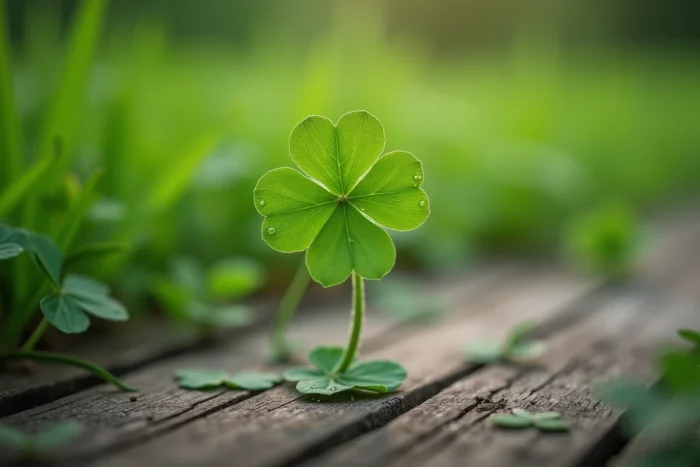
The white clover (Trifolium repens) typically produces three leaflets per leaf. Finding a four-leaf clover remains uncommon, but specimens with 5, 6, or 7 leaflets also exist. What is the actual probability of encountering these variants, and do the meanings attributed to them rest on anything other than folklore?
Genetics of multi-leaf clover: what botany has identified
Lucky charms often present the fifth or seventh leaflet as a completely unpredictable accident. Research in plant genetics nuances this idea. The presence of additional leaflets in Trifolium repens is linked to epistatic gene combinations and chromosomal duplications. These mechanisms are not random in the strict sense.
Some lines selected by agronomists regularly produce clovers with 4, 5, 6, or even 7 leaves on the same plant. The perceived rarity in a wild meadow does not reflect a biological impossibility, but rather the absence of selection pressure favoring these mutations in nature.
This distinction between rarity “in the wild” and rarity “in selected micro-populations” is rarely addressed in articles about the meaning of the 5 or 7 leaf clover, even though it changes the interpretation of the phenomenon.
Four, five, and seven leaf clover: rarity and symbolism comparison
The symbolism attributed to each variant follows a logic of escalation: the more leaflets there are, the greater the supposed “power.” The table below summarizes the most common associations in European folklore and Irish traditions.
| Number of leaflets | Relative rarity | Traditional symbolism |
|---|---|---|
| 3 (standard) | Very common | Trinity, faith (Irish tradition) |
| 4 | Rare | Luck, happiness, protection |
| 5 | Very rare | Financial prosperity, love |
| 6 | Extremely rare | Enhanced luck, harmony |
| 7 | Exceptional | “Universal” luck, longevity |
This table calls for clarification. None of these meanings are based on an identifiable ancient text. The Irish tradition firmly associates the three-leaf clover (shamrock) with Saint Patrick and the Christian Trinity. The transition to the 4-leaf clover as a symbol of luck has been documented in European folklore for several centuries.

In contrast, the meanings attributed to 5, 6, or 7 leaf clovers are a more recent construction, driven by jewelry websites, social media, and personal development content. They vary from source to source without historical consistency.
Influence of the environment on the appearance of additional leaflets
An aspect overlooked by most lucky charm articles: the soil and environment directly influence the frequency of leaflet mutations. Feedback from gardeners and lawn managers shows that certain conditions favor the appearance of multi-leaf clovers.
- Urban lawns enriched with nitrogen, where white clover proliferates as an alternative to traditional grass, concentrate more atypical specimens
- Compacted or polluted soil can cause plant stress that triggers developmental anomalies, including the multiplication of leaflets
- Areas where the same clover plant reproduces by stolons (vegetative reproduction) transmit the mutation to the entire patch, creating “nests” of 4 or 5 leaf clovers
Finding a 5-leaf clover in an urban lawn square does not have the same statistical value as discovering one in an unmaintained meadow. The context of discovery radically changes the actual rarity of the specimen.
Lucky clover: what the symbol says about our beliefs
The four-leaf clover functions as a symbol of luck because it combines two elements: a verifiable rarity (it requires searching) and a recognizable shape (four symmetrical lobes). This psychological mechanism explains why the belief persists across cultures.
For the 5 or 7 leaf variants, the motivation is different. Increased rarity replaces tradition as a source of symbolic value. They are not attributed a precise meaning inherited from a cultural corpus, but a “power” proportional to their supposed improbability. It is more a logic of collection than of structured superstition.
Irish traditions, often cited as the source of these beliefs, focus on the three-leaf shamrock as a national and religious emblem. The four-leaf clover occupies a secondary place, and the 5 or 7 leaflet variants do not appear in documented folklore narratives.
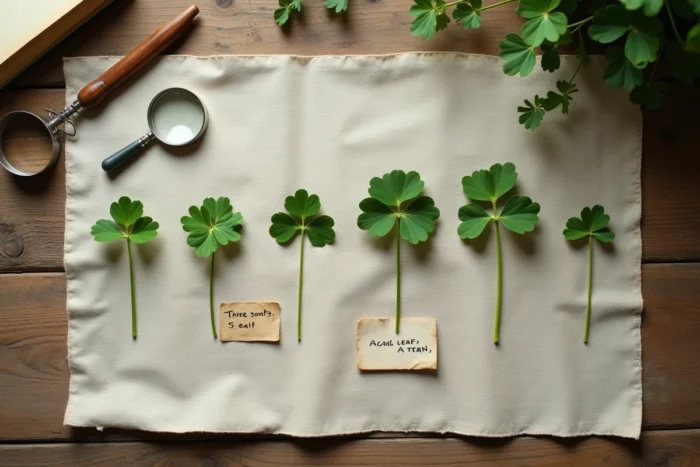
The proliferation of online content attributing specific virtues to each number of leaflets (love for 5, universal protection for 7) is a contemporary construction. These attributions circulate primarily on social media and jewelry shops, where they serve both a commercial and symbolic purpose.
The multi-leaf clover remains a fascinating botanical object. Its rarity in the wild is real, even if it is less absolute than folklore suggests. As for the meanings, they tell more about our relationship with luck than the history of the clover itself.