
The market for travel cribs has segmented in recent years between ultra-light models designed for air transport and heavier versions that also function as playpens. This distinction, rarely specified in buying guides, conditions all the selection criteria. Before comparing mattresses or folding systems, the first question concerns the actual use: frequent transport in the cabin or trunk, long stays at grandparents’ houses, or occasional emergencies.
EN 12227 Standard and Sleeping Surface: What the CE Mark Doesn’t Always Indicate
The travel cribs sold in Europe are linked to the EN 12227:2010 standard, which also covers children’s playpens. It sets requirements for the flat sleeping surface, the maximum thickness of the mattress, and the prevention of suffocation risks. A compliant model bears the CE mark, but this logo does not provide information about the comfort level or the actual firmness of the delivered mattress.
Manufacturers generally provide a thin mattress, sometimes referred to as a “playpen bottom” rather than a real mattress. However, adding a third-party mattress or topper is discouraged by safety authorities, as a mattress that is too thick or poorly fitted creates a gap between the edge of the crib and the sleeping surface, increasing the risk of entrapment.
For parents considering a compact and lightweight baby travel crib, the quality of the original mattress becomes a determining selection criterion, as it cannot be replaced without compromising compliance.
Weight of the Travel Crib and Folded Volume: Thresholds That Change Usage
The difference between a travel crib designed for transport and a classic spare bed lies in two measurable parameters: total weight (including structure, mattress, and cover) and dimensions when folded.
The most compact models on the market weigh less than six kilograms. At this weight, the crib fits in a backpack or qualifies as cabin baggage on certain airlines. In contrast, models that incorporate additional functions (clip-on changing table, play arch, double sleeping level) often exceed eight kilograms.
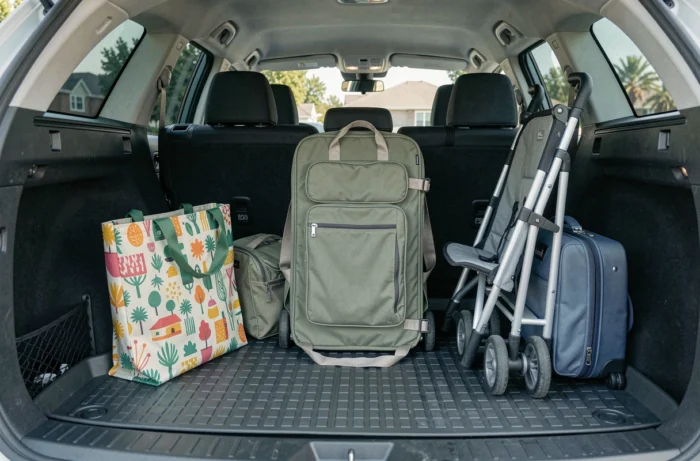
The folded volume matters as much as the weight. A seven-kilogram crib that folds into a compact suitcase format will be easier to transport than a five-kilogram model whose folded structure remains bulky in length. Field reports vary on this point: some parents prefer a slightly heavier weight if the folded format stands upright in a closet or a small car trunk.
Criteria to Check Before Purchase
- Does the weight stated by the manufacturer include the mattress and transport cover, or just the bare structure? The difference can reach one kilogram.
- Do the folded dimensions allow the crib to slide into the trunk with the rest of the luggage, or does it require a dedicated space?
- Is the transport cover provided, and does it have a shoulder strap or handles suitable for the actual weight of the crib?
Folding System: Speed vs. Mechanical Reliability
Two main families of folding mechanisms coexist. The classic “umbrella” folding, where the structure folds in on itself into an elongated block, remains the most common. The new-generation compact folding, adopted by several brands, reduces bulk by folding the bottom up before collapsing the sides.
A quick fold does not guarantee an intuitive unfold. Some models open in one second but require a precise action to lock the bottom, which can unsettle a parent discovering the mechanism at night, in the dark, with a tired child. Testing the assembly and disassembly several times before the first trip avoids this type of unpleasant surprise.
The robustness of the locking mechanism deserves particular attention. The lightest cribs use aluminum structures that withstand wear well, but plastic joints may show signs of fatigue after several hundred opening/closing cycles.
Travel Crib with Play Functions: An Evolving Regulatory Framework
Some travel cribs incorporate play arches or interactive modules, bringing them closer to the toy category in regulatory terms. The Regulation (EU) 2025/2509, published in December 2025, replaces Directive 2009/48/EC on toy safety and comes into full effect on December 12, 2027.
For manufacturers marketing travel cribs with play functions, this change requires an update of technical files, CE marking, and testing according to the EN 71 series. For parents, the practical consequence is simple: a crib purchased before 2027 with playful accessories may no longer comply with the new regulation’s requirements if these accessories are sold separately or replaced.
Minimalist models, without arches or clip-on accessories, are not affected by this change. This point reinforces the appeal of compact travel cribs that focus on the sleeping function without unnecessary additions.
Usage Age and Weight Limits: Adapting the Crib to Growth
Most travel cribs are advertised as usable from birth. In practice, models equipped with a booster or a second sleeping level facilitate laying down and picking up the infant during the first months. This booster is then removed, usually around six months or as soon as the child begins to sit up independently.
- Weight limit: each model displays a maximum load, often around fifteen kilograms, which determines the actual end age of use.
- The depth of the crib once the booster is removed must be sufficient to prevent a standing child from climbing over the edge.
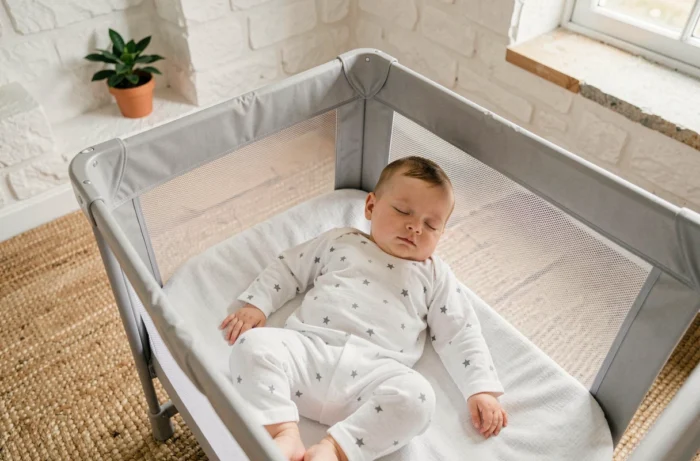
- The mesh side panels allow for proper ventilation and provide reassuring visibility for both the baby and the parents.
The choice of a travel crib comes down to a trade-off between portability and functionality. A compact and lightweight model, compliant with the EN 12227 standard, with a reasonably good quality original mattress and a folding mechanism that you have tested, covers the vast majority of travel situations. Additional functions add weight and, soon, additional regulatory constraints.