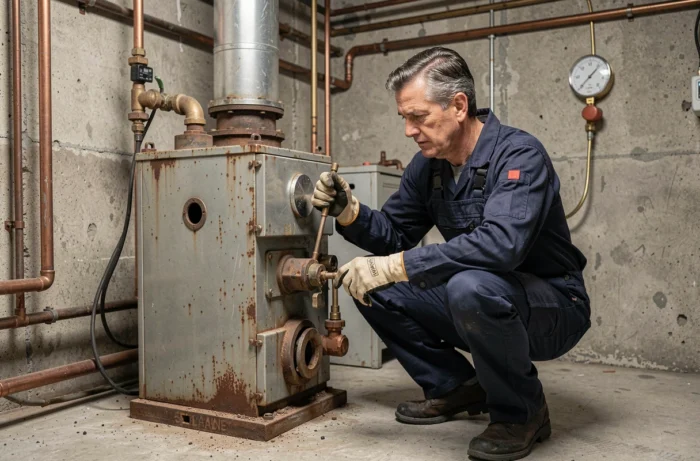
Since June 1, 2025, the Brussels Region prohibits the installation of new oil boilers. If your appliance is still functioning, you can keep it, provided you comply with the annual energy performance checks. However, the day it breaks down, you cannot replace it with an identical model. The question then becomes very concrete: what system should be installed in a home that was designed for nothing but oil?
Oil burner: a technical margin often overlooked
Before planning a complete replacement, one point deserves attention. The replacement of an oil boiler burner remains permitted until December 31, 2034, according to a note from the Union of Cities and Municipalities of Wallonia (UVCW) published in July 2026. Furthermore, the prohibition on replacing the boiler itself in an existing building has been postponed to January 1, 2031.
Specifically, if your boiler has a heat exchanger in good condition but the burner is wearing out, a heating technician can install a new burner without violating regulations. This is not a long-term solution, but it allows you to gain a few years before undertaking a more extensive renovation.
This nuance changes the game for homeowners whose budget does not allow for an immediate replacement. It also gives time to plan insulation work that will make a heat pump or another system truly effective. When you want to replace an oil boiler in Brussels, knowing this timeline helps avoid decisions made in haste.
Air-water heat pump in an old house: the real criterion is the radiator
You have probably read everywhere that the air-water heat pump (PAC) is the ideal replacement solution. This is true, under one often underestimated condition: your radiators must be able to operate at low temperature.
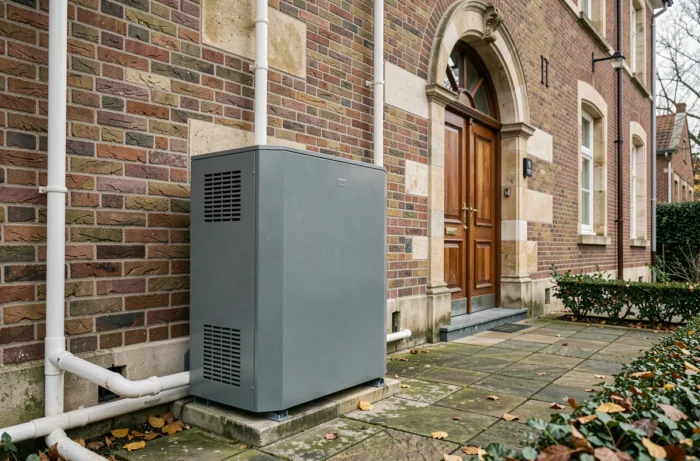
An air-water PAC produces water between 35 and 55 °C under the most common conditions. An oil boiler, on the other hand, sent water at 70 or 80 °C to radiators sized for that temperature. If your radiators are too small compared to the heat losses of the home, the PAC will have to work constantly, consume a lot of electricity, and will not provide the expected comfort.
Before investing, have two things checked by an installer:
- The capacity of your existing radiators, expressed at 50/30 °C (low temperature regime) and not at the 75/65 °C regime indicated on older technical sheets. An oversized radiator at the time may be suitable for low temperature.
- The level of insulation of your envelope (roof, walls, windows). The better the insulation of the home, the less power is needed, and the more the PAC operates within its optimal efficiency range.
- The location of the outdoor unit. In Brussels, the constraints of party walls and noise are real, especially in townhouses or on the ground floor of a building.
An improperly sized PAC costs more to operate than a condensing gas boiler. The ecological gain only materializes if the installation is adapted to the existing building.
Condensing gas boiler: the most common transitional solution in Brussels
In many Brussels homes, the connection to natural gas already exists. Switching from an oil boiler to a condensing gas boiler remains the simplest and least costly scenario in terms of work.
The heat exchanger is more compact than an oil boiler, the tank disappears (which frees up space), and the connection to existing radiators generally requires no modifications. The gas boiler operates at high temperature, which is suitable for older radiators without replacement.
This option has an obvious limit: natural gas remains a fossil fuel. The Brussels Region plans to gradually restrict gas boilers in the coming years. Installing a gas boiler today is betting on a lifespan of fifteen to twenty years, during which regulations may still evolve.

For a homeowner who cannot insulate immediately or whose home is not compatible with a PAC, the condensing gas boiler remains a realistic step before a deeper renovation.
Hybrid system and financing: balancing immediate cost and energy bill
The hybrid system combines a small air-water heat pump with a condensing gas boiler. The PAC handles heating when outdoor temperatures are mild. When it is very cold, the gas boiler takes over.
This compromise has a concrete advantage: it adapts to moderately insulated homes without requiring the replacement of radiators. The PAC covers the majority of annual heating hours, and the boiler acts as a backup.
Financing the replacement without Renolution grant
Renolution grants specific to heating are suspended in Brussels in 2026. Two financial levers remain:
- The 6% VAT applies to renovation work in homes over ten years old, including the installation of a heat pump or gas boiler.
- The ECORENO loan, offered by certain banks, finances energy renovation work at a preferential rate.
- The removal of the oil tank (mandatory after decommissioning) represents a cost to be included in the overall budget, but it frees up space and eliminates a risk of soil pollution.
The absence of heating grants changes the calculation. A hybrid system costs more to purchase than a gas boiler alone, but the annual energy bill decreases thanks to the portion covered by the heat pump. The decision depends on the price of electricity compared to gas, a ratio that varies each year.
Each Brussels home has its own constraints: surface area, insulation, type of radiators, access to gas, space for an outdoor unit. The best approach remains to have an energy audit conducted before signing a quote, to avoid oversizing or undersizing the installation. A well-calibrated replacement from the start costs less than a correction afterward.