
Your adult son no longer answers the phone, or every family meal turns into a showdown. This situation is not uncommon. Sociologist Rin Reczek (Ohio State University) observed that about 26% of adult children have experienced at least one period of estrangement from their father. The parent-adult child conflict often follows years of accumulated tensions, rarely stemming from a single isolated event.
Why the conflict with an adult son persists over time
Have you ever noticed that a trivial disagreement (a comment about his lifestyle, a remark about his partner) can trigger a disproportionate reaction? It is rarely the topic of the day that is the problem. The visible conflict masks older frustrations.
In her interviews with 68 adults who have cut off contact with a parent, Rin Reczek concludes that the decision comes after years of suffering and failed attempts to resolve the issue. Adult children describe this break as a last resort, not as an impulsive gesture.
Practically speaking, this means that if your son is distancing himself, there is likely a history of moments when he felt misunderstood or controlled. Acknowledging this does not mean accepting blame. It means understanding that the current relationship carries the weight of all past interactions.
Before trying to manage the relationship with my son, it is helpful to take a step back and consider what in your shared history may have created this gap. Without this understanding work, any attempt at reconciliation is likely to stumble over the same pitfalls.
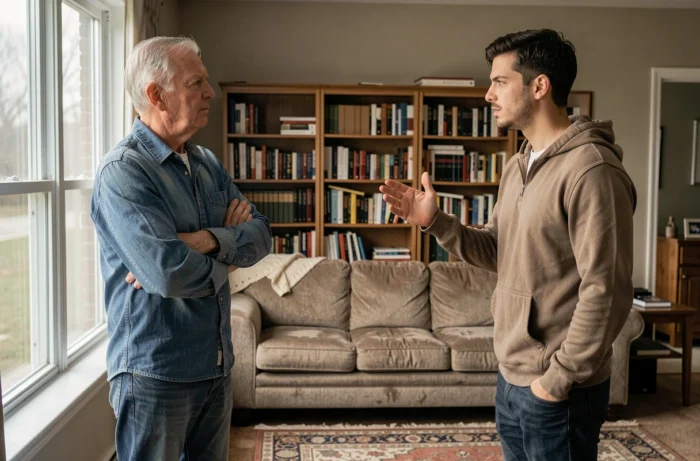
Boundaries and mutual respect: setting a framework without controlling
The first instinct of many parents facing conflict is to want to “fix things.” Calling, insisting, apologizing for everything and anything. This approach comes from good intentions, but it reproduces a pattern in the parent-child relationship: the parent sets the pace, the child follows.
With an adult son, the bond is rebuilt on an equal footing. It is no longer about guiding, but about coexisting.
What “setting boundaries” means in practice
Setting boundaries does not mean cutting off communication. It means defining what you accept and what you do not accept in exchanges, and then clearly articulating it.
- Refusing conversations where the tone escalates without slamming the door: “I prefer we talk about this when we are calmer” is a healthy boundary, not a rejection
- Accepting that your son also sets his own boundaries (frequency of calls, topics he does not want to discuss) without taking it as an affront
- Differentiating your emotional needs from his obligations: he is not obligated to fill your loneliness or validate your past parenting choices
This framework protects the relationship. It prevents every exchange from becoming a minefield.
Family therapy and mediation: when dialogue alone is not enough
When attempts at discussion consistently lead to confrontation, a third party can help unlock the situation. There are two options, and they serve different purposes.
Family mediation focuses on a specific conflict (an inheritance, a disagreement about grandchildren, a dispute related to your son’s partner). The mediator helps both parties find a concrete agreement. Recent data shows that more and more families are choosing mediation over court to resolve their disputes.
Family therapy, on the other hand, digs deeper. It explores the relational dynamics that have fueled the conflict for years. It is a longer process, but more transformative.
What to do if your son refuses any outside help
This is a common scenario. Many adult sons associate therapy with an admission of weakness or believe that “it’s the parent who has a problem, not them.”
Starting therapy alone is still useful, even if your son does not participate. A therapist helps you identify your own reactive patterns: do you feel guilty all the time? Do you get defensive at the slightest criticism? These realizations change the way you interact, and by extension, the dynamics of the conflict.

Reconciliation with your adult child: what works and what makes it worse
Not all attempts at reconciliation are equal. Some well-intentioned approaches produce the opposite effect.
- Sending long messages to “clear the air”: your son may perceive them as additional pressure. Prefer short and open messages (“I’m thinking of you, I’m available whenever you want”)
- Enlisting other family members to intervene: this gives your son the impression of being cornered and reinforces his decision to distance himself
- Pretending nothing happened at the next meal: ignoring the conflict does not resolve it; it postpones it
What works best takes time. Respecting your son’s silence without interpreting it as a definitive rejection is often the first step. Sociologist Andreea Nica (article published in Frontiers in Sociology) observed that adult children who distance themselves often describe concrete benefits: a regained sense of security, better mental health.
This information is hard for a parent to hear. It does not mean you are toxic. It means your son needs space to rebuild before he can come back to you.
Parent-child reconciliation does not follow a timeline. Some families reconnect after a few months, others after several years. Keeping the door open without forcing the way through remains the most effective posture, according to family mediation professionals. An occasional message, without reproach or guilt, reminds your son that the bond still exists, unconditionally.