
Your cat has not returned for several hours and this delay is unusual for him. Before succumbing to panic, we can structure the initial actions to increase the chances of finding him. A cat that disappears often does not stray far, usually just a few dozen meters, but it hides in places we might not spontaneously think of.
Search for your cat at ground level before widening the perimeter
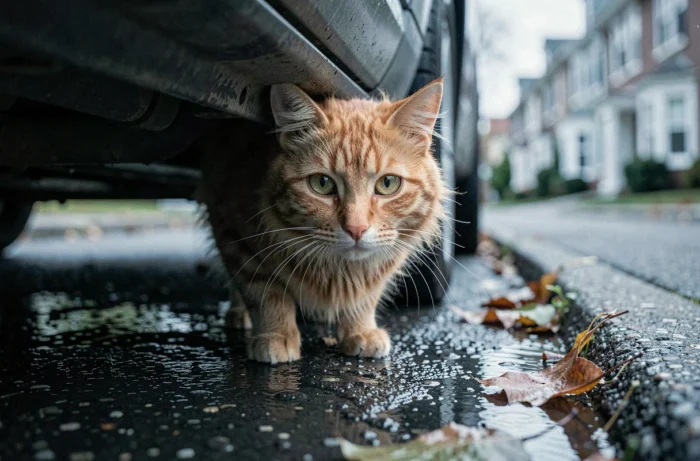
The most common reflex is to walk around the neighborhood calling for the animal. In practice, this approach works poorly. A stressed or injured cat remains still and silent, often within two hundred meters of home. It will not respond to a call made from the sidewalk.
Better results are obtained by methodically searching the hiding spots close to the point of escape. Garage, under the terrace, dense hedge, garden shed, space between a wall and a fence: these micro-zones are the first to inspect. The idea is to crouch down, look at the ground at cat level, and use a flashlight even during the day to spot the reflection of its eyes under a dark corner.
There are tips for finding a lost cat that detail this concentric search method, from the closest to the farthest.
Also ask immediate neighbors to check their outbuildings. A cat can slip into a technical room or an open basement for a few minutes, then find itself trapped with no way out. The hypothesis of accidental confinement is often underestimated, yet it explains a significant portion of disappearances.

Search slots: why search for your cat at night
We tend to scour the neighborhood in the middle of the afternoon, when there is noise, foot traffic, and cars. A hidden cat will not move under these conditions. Recent sources converge on one operational point: searching at dusk, dawn, or in the middle of the night is more effective.
The environment is calm, background noise decreases, and a frightened cat is more likely to venture out of its hiding place to look for food or water. You can then place a bowl of strongly scented food (wet food, tuna) near the front door or the supposed point of escape, and monitor from a distance.
The monitored bowl technique
Place the food in the evening, ideally with a recently worn piece of clothing (your scent reassures the animal). If you have the ability to film the area with a phone in time-lapse mode or a camera, this allows you to check if the cat returns without your presence. Some cats will not approach as long as they detect a human presence, even familiar.
This simple setup yields results in the first few nights. After a few days, the cat may have expanded its escape perimeter, and the strategy needs to be adapted.
Loss declaration on I-CAD: the timeframe that changes everything
Many owners think they must wait twenty-four hours before declaring a disappearance. This idea is false. You can report the loss as soon as the absence seems abnormal, directly on the national identification file I-CAD.
This declaration is crucial because it allows anyone who finds your cat (veterinarian, pound, shelter, individual) to connect the animal’s microchip to your contact information. If the identification is up to date, the process is quick. If your contact information has changed since adoption or moving, the report will be useless.
Check your contact information before the loss
This is a preventive point that is often overlooked. Update your phone number and address on I-CAD before a problem occurs. On the day of the disappearance, you won’t be focused on searching for your login details. This verification takes a few minutes and saves hours in case of a search.
- Log in to your holder space on the I-CAD website and check that the displayed phone number is correct.
- Confirm that the postal address matches your current home, especially after a move.
- If your cat is not yet identified by microchip, know that identification is mandatory and is the only reliable link between the animal and its owner.
Relay the disappearance locally: which channels really work
There are dozens of platforms to publish a lost cat notice. In practice, feedback varies on this point, but some channels yield more concrete results than others.
Neighborhood groups on social media (communal groups, local support groups) generate rapid dissemination among people living in the same area. An announcement with a clear photo, the exact location of disappearance, and the date directly reaches neighbors who may have seen the animal.
- Post a color photo of the cat in local shops, at veterinarians, and at the town hall.
- Contact shelters and pounds in the department, not just those in your municipality.
- Notify veterinarians within several kilometers: an injured cat picked up by a passerby will often be taken to the nearest clinic.
- Regularly check lost animal announcements, including those posted by individuals.
Consistency matters more than volume. Following up with shelters and checking announcements every two or three days increases the chances of spotting your cat if someone has taken it in in the meantime.
A runaway cat often returns on its own when the reason for its departure disappears (work completed, heat passed, rival animal gone). Keeping the food bowl accessible, leaving a window or cat flap open at night, and not moving its litter box are all olfactory signals that facilitate its return. Most reunions happen in the first few days, provided that the nearby hiding spots have been covered and the identification network activated from the start.