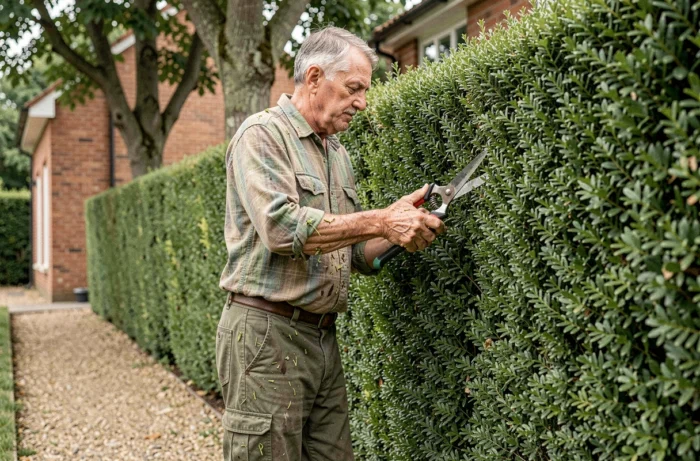
Hedge trimming is not just a matter of a blade passing twice a year. The choice of timing, cutting angle, and knowledge of the supporting wood determine the density, longevity, and health of the shrub. Here, we address the technical points that most general public guides overlook.
Hedge Trimming and This Year’s Wood: Understanding the Physiology of Cutting
A recurring mistake is trimming without distinguishing between this year’s wood and lignified branches. On a laurel or privet, this year’s shoots have a soft, light green epidermis and heal quickly. Cutting into old wood, on the other hand, exposes a tissue that takes longer to close, making it susceptible to fungal infections.
On boxwood, the cut should remain in the upper third of this year’s shoots to avoid drying out the inner branches. A boxwood trimmed too short in the middle of summer loses its ability to regenerate dense foliage at the base, creating gaps that are difficult to fill later.
Cypress presents a particular case: it hardly regrows on old wood. A severe cut leaves permanent brown areas. We recommend never exceeding one-third of the leaf mass in a single intervention and working in successive passes over two seasons to gradually reduce the width of an overgrown cypress hedge.
Additional resources on cutting techniques suitable for each species are available at sculpte-haie.com, which details the actions by type of shrub.
Hedge Trimming Calendar: Legal and Biological Constraints Often Confused
The period from mid-March to mid-August is often presented as a formal prohibition on trimming. The legal reality is more nuanced. No general national prohibition targets individuals during nesting. The Environmental Code prohibits the intentional destruction of nests, eggs, or breeding sites of protected species, regardless of the date.
The CAP conditionality prohibits farmers from trimming hedges from April 1 to July 31. Local authorities may impose additional constraints through municipal orders. Therefore, an individual trimming their hedge in June does not automatically commit an offense, but they must check for the absence of an active nest before proceeding.
From a biological perspective, the best trimming window depends on the species:
- Spring-flowering shrubs (forsythia, spiraea) should be trimmed just after flowering, never before, to avoid removing flower buds already formed on last year’s wood.
- Evergreen hedges (laurel, privet, cypress) are ideally trimmed in late spring, followed by a second pass in September when the sap descends.
- Deciduous field hedges (hornbeam, beech) can withstand winter trimming, outside of frost, which allows work on the structure without foliage.
Cutting Angle and Trapezoidal Profile: The Technique That Avoids Gaps at the Base of the Hedge
Trimming a hedge perfectly vertical is the most common reflex, and the most counterproductive. A strictly straight profile deprives the base of light: the leaves at the top create a screen, the lower branches become etiolated, and the hedge gradually becomes bare at the bottom.
The trapezoidal profile, wider at the base than at the top, ensures uniform sunlight across the entire height. We observe a marked density difference between a hedge trimmed vertically and one whose top is reduced by a few centimeters compared to the base.
To achieve this profile, the most reliable method remains a taut string between two stakes, with a slight inward angle at the top. A hedge trimmer held slightly tilted (the blade forming an angle of about five degrees from the vertical) is enough to create this conicity without the result appearing asymmetrical to the eye.

Filling a Gap in a Laurel or Boxwood Hedge
A gap in a hedge often signals a root problem (compaction, excess water) or a light imbalance. Before replanting, the cause must be identified. On a laurel, localized cutting back to two or three buds stimulates the emergence of lateral shoots within a few weeks if the intervention takes place in April-May.
On boxwood affected by the box tree moth or decline, replacing it with Ilex crenata (Japanese holly) offers a visually similar appearance without the current health constraints of boxwood. The recovery is slower in the first year, but the density achieved in the long term remains comparable.
Managing Trimming Waste: Shred Rather Than Dispose
The green waste from hedge trimming represents a significant volume, especially on free hedges or field hedges. Shredding on-site transforms these residues into mulch that can be directly spread at the base of the hedge.
Leafy shreddings decompose in a few months and nourish the soil without acidifying, unlike shreddings from conifers (cypress, thuja) which are better composted separately for a year before use. This return of organic matter at the base of the shrubs reduces summer watering and limits the emergence of weeds.
For hedges at property boundaries, check local regulations on open-air burning, which is prohibited in most municipalities. The shredder remains the most coherent option, both agronomically and regulatory-wise.
Properly conducted hedge trimming relies on three interconnected parameters: knowledge of the supporting wood of each species, adherence to an appropriate cutting profile, and a schedule aligned with the plant’s biology rather than a seasonal routine. A methodically trimmed hedge gains density each year instead of gradually becoming sparse.