The fashion trend cycle is accelerating, but the spring-summer 2026 season marks a more structural than stylistic turning point. Between legislation that reshuffles the cards of consumption and dress codes that move away from the total look, the choice of pieces for a chic and original style now relies on criteria different from those of previous seasons.
Anti-fast fashion law and fashion trends: what concretely changes for your wardrobe
The anti-ultra-fast-fashion bill definitively adopted by Parliament on June 29, 2026, is not merely symbolic. The text imposes a progressive financial penalty per piece that can reach 20 euros by 2030, capped at half the price excluding tax. Platforms like Shein or Temu will see their micro-trends at rock-bottom prices become structurally more expensive in the French market.
The total ban on advertising for these brands, including through influencers, and the obligation to display messages encouraging sobriety and repair on their sites profoundly alter the fashion ecosystem. Sponsored content that massively influenced clothing choices is disappearing from the French landscape.
For those seeking a chic and original style, the direct consequence is a shift towards longer-lasting pieces. We are already observing a shift in purchases towards mid-range brands and second-hand circuits, where it becomes possible to discover the chic spot on Pop Shot to find standout pieces without relying on these platforms.
Trendy cuts and materials for spring-summer 2026: choices that hold up
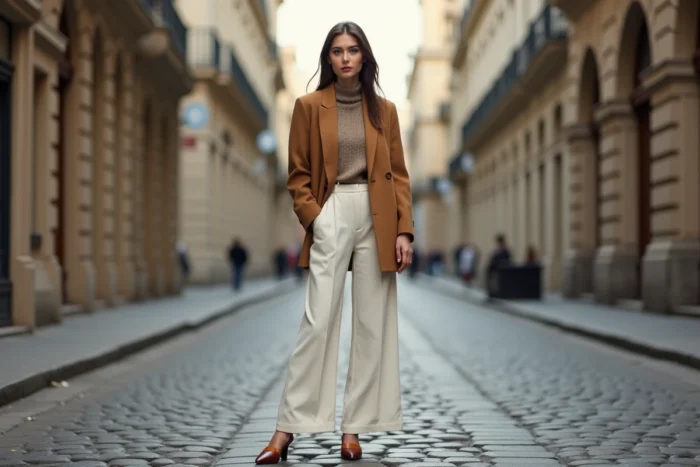
The structured wide pant remains the dominant cut of the season, but its appeal lies in the construction details. Defined waist, ample fall without excessive volume, sharp pleats: it is the tension between loose and precise that distinguishes a well-cut piece from a simple floating pant.
The long fluid dress, carried by the poetcore trend visible at Loewe, Miu Miu, or Saint Laurent, operates on a similar register. The fluidity of the fabric should not mask the absence of structure. The most successful versions combine a fabric with a beautiful drape (crepe, washed satin) with anchoring points: a thin belt, fitted armholes, visible seams at the back.
On the color side, the palette divides into two families that coexist without mixing:
- Saturated shades (orange, butter yellow, olive green) worn in blocks on a single piece, with the rest of the outfit remaining neutral
- Natural tones (ecru, beige, off-white) treated in textured layering, where the contrast comes from the materials rather than the colors
- Sky blue, a transitional color that works both as a strong piece and as an accessory
The classic trap is to multiply trendy colors in the same look. An original style relies on a single, bold color choice, not on an accumulation.
Coordinated sets and expressive accessories: building a coherent fashion look
The coordinated set (matching top and bottom in the same fabric, pattern, or color) stands out as the most effective alternative to the monochrome total look. Its technical advantage is simplifying outfit construction while producing a strong visual impact. The most interesting versions play with asymmetrical proportions: a short jacket with palazzo pants, a crop top with a voluminous midi skirt.
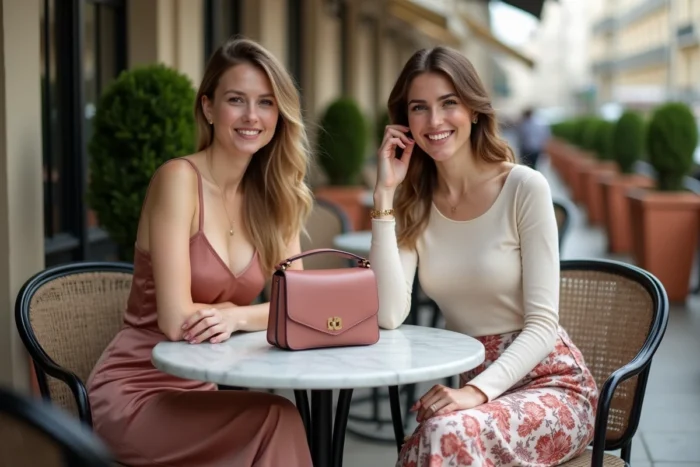
We recommend treating the coordinated set as a neutral base and concentrating originality on a single expressive accessory. An architectural brooch, oversized earrings, or a geometric-shaped bag function as accessory pieces that define a style without overwhelming the silhouette.
The common mistake is to pair an already graphic set with equally loaded accessories. The proportion rule remains simple: the more structured or colorful the outfit, the more minimal the accessory should be (and vice versa).
Circular fashion and chic style: the second-hand market as a lever for originality
Circular fashion is no longer a militant positioning; it is a rapidly expanding economic segment. Insufficient demand remains the main barrier to model change for brands, but the growth figures for the circular market show a clear trajectory towards normalization.
Vintage and second-hand pieces offer a structural advantage for an original style: they are by definition unique in their wearing context. A 1990s jacket altered by a local tailor will not be worn by three other people on the same evening.
To leverage this, a few selection criteria deserve attention:
- Favor pieces whose cut corresponds to current proportions (shoulders and waist are the most reliable reference points)
- Check the condition of seams and closures before purchase, as the cost of alterations can exceed the value of the piece
- Target noble materials (wool, silk, leather) that age better than synthetics and are easier to repair
The Lille flea market 2026 confirmed this trend, with record attendance at selected thrift and decade-sorted vintage stands.
The true marker of a chic style this season is not measured by the number of trendy pieces accumulated. It is the ability to combine a few well-chosen pieces, whether new or second-hand, around a mastered silhouette and a tightened palette. The anti-fast fashion law, by reducing the noise of disposable micro-trends, paradoxically makes this selection work more accessible.