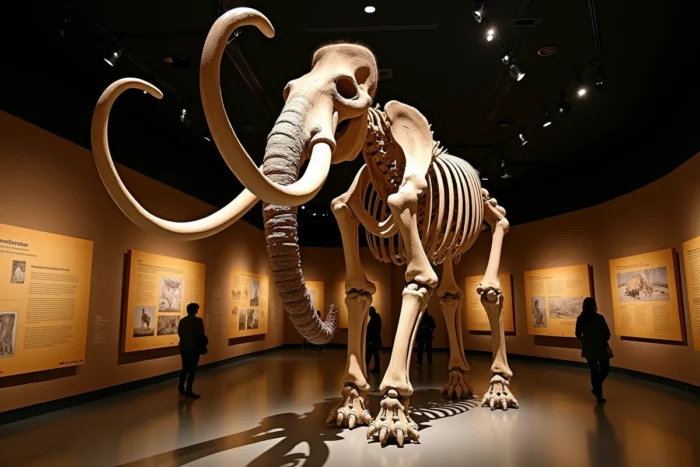
Woolly mammoths (Mammuthus primigenius) occupied the cold steppes of Eurasia and North America for several hundred thousand years. Their extinction did not correspond to a single event: continental populations went extinct long before the last isolated groups on Arctic islands. Understanding this extinction requires examining several mechanisms that acted simultaneously or in cascade, depending on the regions and periods.
Immune Vulnerability and Pathogens: An Underestimated Angle
Most syntheses on the extinction of mammoths focus on climate and human hunting. Recent work on ancient DNA extracted from frozen remains opens another avenue: the role of pathogens in the terminal phases of extinction.
Genomic analyses of late mammoths show signatures of physiological stress and increased immune vulnerability. When an animal population shrinks, genetic diversity drops, weakening defenses against parasites, bacteria, or viruses. Emerging diseases, including zoonoses transmitted by other species or by humans, could have struck already weakened groups.
This health dimension remains very little addressed in popular content. It complements the picture without replacing other factors: a mammoth weakened by a pathogen is less able to withstand a harsh winter or hunting pressure, even if moderate. Several researchers are currently exploring why mammoths went extinct according to Animal Time by integrating this immunological data into existing models.

Post-Glacial Warming and Transformation of Mammoth Steppes
The climate warming at the end of the Pleistocene profoundly altered the habitat of woolly mammoths. The steppe-tundra, a dry biome rich in grasses, was their main food source. With rising temperatures, this environment gave way to peat bogs, coniferous forests, and wet meadows, which were far less nutritious for such a large herbivore.
The transformation was not uniform. Western Europe lost its cold steppes earlier than Eastern Siberia. Continental mammoths disappeared in several regional waves, spread over millennia. In North America, the retreat of glaciers opened new biological corridors, but the plant species that settled there no longer matched the dietary needs of mammoths.
Wrangel Island: A Natural Laboratory
The last known mammoths survived on Wrangel Island, north of Siberia, for several millennia after the disappearance of continental populations. This island refuge still offered conditions similar to the steppe-tundra. Geographical isolation preserved these mammoths from contact with humans for a long time, but also drastically reduced their genetic diversity.
DNA analyses of these last specimens reveal an accumulation of deleterious mutations, a phenomenon typical of small isolated populations. Genes related to smell, coat quality, and fertility showed functional alterations. This genetic erosion likely made the colony vulnerable to a singular event (epidemic, extreme cold wave, storm) that, in a healthy and large population, would not have caused extinction.
Human Hunting and Pressure on Pleistocene Megafauna
The expansion of human populations in Eurasia and North America coincides with the decline of megafauna. Mammoths were among the prey of Upper Paleolithic hunters, as evidenced by archaeological sites where mammoth bones and flint tools are associated.
The debate centers on the intensity of this hunting. Killing an adult mammoth represented a technical feat and a considerable risk. Several hypotheses coexist:
- A hunting strategy targeting young and weakened individuals, sufficient to shift the demographics of a slowly reproducing species (gestation of nearly two years, one calf per litter)
- An indirect disturbance from bushfires and landscape alteration due to human activity, which reduced available habitat
- A combined effect where hunting does not need to be massive to accelerate an already ongoing decline due to climate change
Mathematical models show that even low harvesting, applied to a population already weakened by habitat loss, is enough to make extinction irreversible in just a few generations.

Extinction of Mammoths and Transition to Agriculture
The disappearance of large herbivorous megafauna (mammoths, woolly rhinoceroses, steppe bison, megaceros deer) had profound ecological consequences that go beyond mere faunal records. Syntheses in agricultural history suggest that the extinction of these large herbivores favored the emergence of the first agricultural societies.
Without massive herds grazing and trampling vegetation, seed plants and wild cereals were able to colonize larger areas. Competition for plant biomass decreased, and the damage caused to nascent crops by large herbivores disappeared with them.
This link between megafauna extinction and the Neolithic transition remains an active research field. The end of the mammoths is not just the closing of a biological chapter; it is also one of the conditions for opening another.
A Collapse with Multiple Causes
No single factor explains the disappearance of mammoths. The current scientific consensus points to a convergence of pressures:
- A rapid climate change that destroyed their main habitat
- Human hunting that accelerated the decline of reduced populations
- Genetic erosion in relict populations, amplifying vulnerability to diseases and environmental hazards
- A possible role of pathogens in the final phases, still under investigation
The extinction of mammoths remains a case study for conservation biology. The mechanisms that led to their disappearance (habitat fragmentation, loss of genetic diversity, cumulative anthropogenic pressures) are the same as those threatening species today, such as the Asian elephant or the Sumatran rhinoceros. The difference lies in the speed: what unfolded over millennia for mammoths is happening in just a few decades for current wildlife.